

In the modern smart home, small devices require equally compact and reliable power sources. As an industry leader in household power solutions, Bevigor understands that the evolution of battery technology goes hand-in-hand with safety and everyday usability. Recently, a major shift has swept through the retail landscape: the implementation of Reese's Law.
Passed to protect infants and young children from the severe hazards of accidental battery ingestion, this federal regulation mandates strict child-resistant packaging requirements. However, while this legislation is an undeniable victory for childhood safety, it has introduced an unexpected, real-world conflict for multi-generational families.

The very barriers designed to keep small fingers out are making everyday access a painful struggle for seniors and individuals living with physical limitations like arthritis.
Understanding this design tension is essential for managing a modern household safely. By exploring how these regulations alter our daily routines, why the physical properties of these power cells demand such rigorous safeguards, and how to safely bridge the accessibility gap, consumers can maintain both a secure home environment and a functional, self-sufficient lifestyle.
The Hidden Risks of the Standard Coin Cell Battery
Why a Small Coin Cell Battery Is Uniquely Dangerous
A standard coin cell battery is a compact, single-cell power unit frequently valued for its longevity and stable voltage output. However, its thin, disc-like shape makes it highly dangerous if swallowed by infants or curious toddlers.
The core hazard extends far beyond a simple choking threat. When a lithium coin cell battery becomes lodged in a narrow throat or esophagus, it creates a continuous electrical circuit with the surrounding moist tissue. This circuit triggers a rapid chemical reaction that generates hydroxide ions, leading to severe electrochemical burns.
Within as little as two hours, these burns can cause permanent, life-threatening damage to the esophagus and surrounding internal organs. Because the early symptoms can easily be mistaken for a common cold or a minor stomach bug, safety agencies treat any suspected ingestion as an absolute medical emergency. For a clear, caregiver-friendly overview of the hazard and why speed matters, read the CPSC's Button Cell and Coin Battery Information Center.
Common Household Devices Driven by a Coin Cell Battery
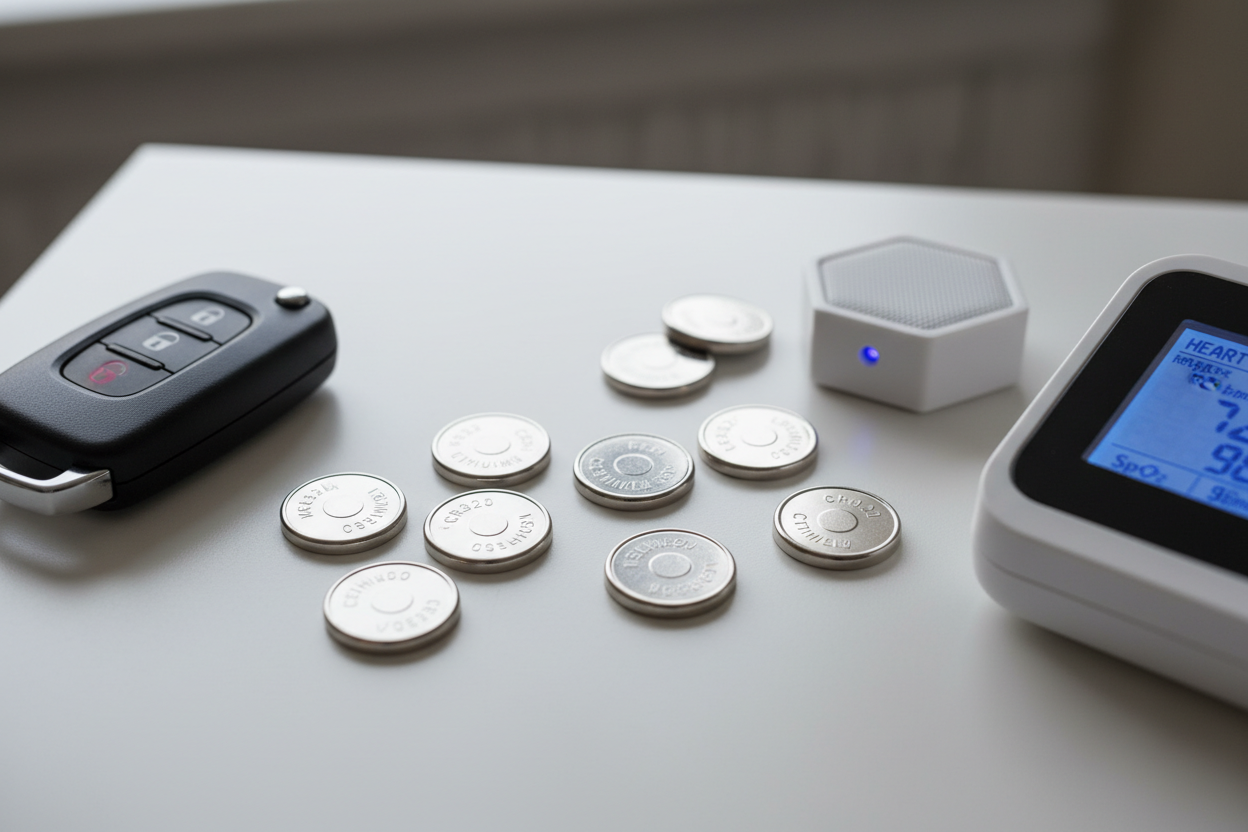
Because of their high energy density, these low-profile power sources are integrated into numerous common electronics. Families frequently interact with them daily without realizing how prevalent they are. Devices that regularly rely on a coin cell battery include:
- Television and streaming device remote controls
- Keyless entry fobs for vehicles
- Digital kitchen scales and medical thermometers
- Smart home contact sensors and security alarms
- Hearing aids and compact wearable medical devices
How Reese's Law Changes Coin Cell Battery Packaging
Why New Coin Cell Battery Packs Feel Harder to Open All at Once
Many consumers did not notice the underlying regulatory shift until it directly disrupted their household routines. Battery packages that could once be effortlessly peeled back or popped open now require deliberate coordination, sharp tools, or scissors.
This sudden transition is due to the enforcement timelines of Reese's Law, which required manufacturers to re-engineer their retail packaging to meet strict child-resistant performance standards. The goal is to ensure that a child under five cannot easily access the primary cell, resulting in a packaging style that requires multiple distinct physical actions to open.
The Regulatory Rollout Affecting Coin Cell Battery Inventory
The reason some households are noticing these changes "all at once" comes down to how retail supply chains operate. Once a federal enforcement date passes, manufacturers must ship compliant merchandise, but retail stores are permitted to sell through their existing older inventory.
Consequently, consumers may experience a transitional period where different packaging styles for the same coin cell battery model coexist across different retailers, or even hang side-by-side on the same store shelf. Over time, the older, non-compliant packaging will disappear entirely from the market.
The Multi-Generational Dilemma of Coin Cell Battery Safety
When a Child and a Grandparent Both Face Coin Cell Battery Risks
Modern households are increasingly multi-generational, meaning that safety measures must account for individuals at both ends of the age spectrum. While a home might not have young children living there permanently, visiting grandchildren can easily discover loose cells.
Conversely, even if a household consists primarily of young parents and toddlers, a grandparent living with them may rely heavily on small devices like hearing aids. This setup creates a two-directional risk framework: young children are endangered if they find unsecured cells.
At the same time, older adults are placed at risk if the protective packaging becomes so physically demanding that it compromises their independence.
The Unintended Consequences of Hard-to-Open Coin Cell Battery Packs
When safety mechanisms become excessively frustrating, human behavior naturally searches for shortcuts. For seniors suffering from severe arthritis or diminished grip strength, an unyielding plastic blister pack can become an insurmountable barrier.
My neighbor Benjamin recently shared his deep frustration with the new packaging mandates. He noted that while protecting children is vital, the current senior-proof designs make it nearly impossible for older adults with arthritic hands to access their necessary batteries without assistance.
When faced with this obstacle, an older adult may cut open an entire package at once and transfer the loose, unprotected cells into an unsealed jar or an unsafe container.
Alternatively, they might leave a half-cut, jagged plastic pack sitting on a nightstand or kitchen counter within easy reach of a child. This counteracts the protective purpose of the law, trading a secure package for an open household hazard.
Balancing Child Delay and Senior Accessibility for Every Coin Cell Battery
Designing a Coin Cell Battery for Child Delay, Not Impossibility
To navigate this domestic challenge, caregivers must reframe their understanding of "child-resistant" packaging. In the field of consumer safety engineering, no package is considered entirely child-proof. Instead, child-resistant packaging is explicitly designed to serve as a child-delaying mechanism.
The specific combination of tough polymers, embedded layers, and double-action opening mechanisms is calibrated to resist a young child's manual dexterity for a specific duration. This critical delay buys valuable time for an attentive parent or caregiver to notice the situation, intervene, and remove the hazard before the cell is liberated.
Managing the Design Tension of the Modern Coin Cell Battery
The ongoing manufacturing challenge lies in the direct physical intersection of child safety and senior usability. A package designed to stymie the grip, teeth, and fingernails of a determined four-year-old inherently demands a level of force and coordination that closely mirrors the physical limitations of a 74-year-old with joint inflammation.
Consumer experts and manufacturers are working to develop smart packaging solutions—such as specialized pull-tabs or sliding mechanisms that require cognitive steps rather than raw physical strength—to satisfy federal safety mandates without alienating the elderly population.
Safe Storage and Handling Solutions for Your Household Coin Cell Battery
To maintain an optimal balance between maximum safety and reliable accessibility, households should establish clear protocols for managing their coin cell battery supply. Rather than relying solely on retail packaging to prevent accidents, implementing structured storage habits ensures that cells remain out of sight of children while remaining organized for adult use.
The following table outlines standard household practices, comparing unsafe storage behaviors with recommended safety alternatives:
|
Unsafe Handling Behavior |
Recommended Safe Alternative Solution |
|
Leaving partially cut plastic blister packs on counters or nightstands. |
Storing active packages immediately inside a high, locked cabinet or lockbox. |
|
Emptying multiple loose cells into a single drawer, bowl, or jar. |
Keeping cells separated in their original slots or using a dedicated organizer. |
|
Throwing depleted cells directly into an open kitchen trash can. |
Taping both sides of used cells immediately and placing them in a secure disposal bin. |
|
Changing device cells at floor level or within plain view of toddlers. |
Replacing power cells on a high surface and placing old cells out of reach instantly. |
When storing coin cell batteries, users must also remember that allowing multiple cells to touch can cause an accidental electrical short. This contact can rapidly discharge the cells, rendering them useless when needed, or generate localized heat. Keeping them stored flat, insulated, and out of reach preserves their shelf life and protects the household.
Conclusion
The implementation of Reese's Law represents a vital step forward in reducing severe childhood injuries caused by accidental ingestion, yet it highlights a complex design friction in everyday usability.
As a dedicated provider of household power solutions, Bevigor supports packaging advancements that safeguard our most vulnerable family members. At the same time, we recognize that true home safety must remain inclusive of seniors and individuals facing physical dexterity challenges.
By understanding the chemical risks associated with a swallowed coin cell battery, recognizing that child-resistant packaging is meant to buy intervention time, and adopting rigorous household storage protocols, families can successfully protect their children without compromising the autonomy and comfort of their elders. Maintaining a secure, organized home allows everyone to enjoy the benefits of modern consumer electronics safely and reliably.



Share:
Why 1.5V Rechargeable Lithium AAs Jam Your Devices (And How to Fix It)
Understanding Reese's Law: New Safety Standards for Retail and Household Battery Products