

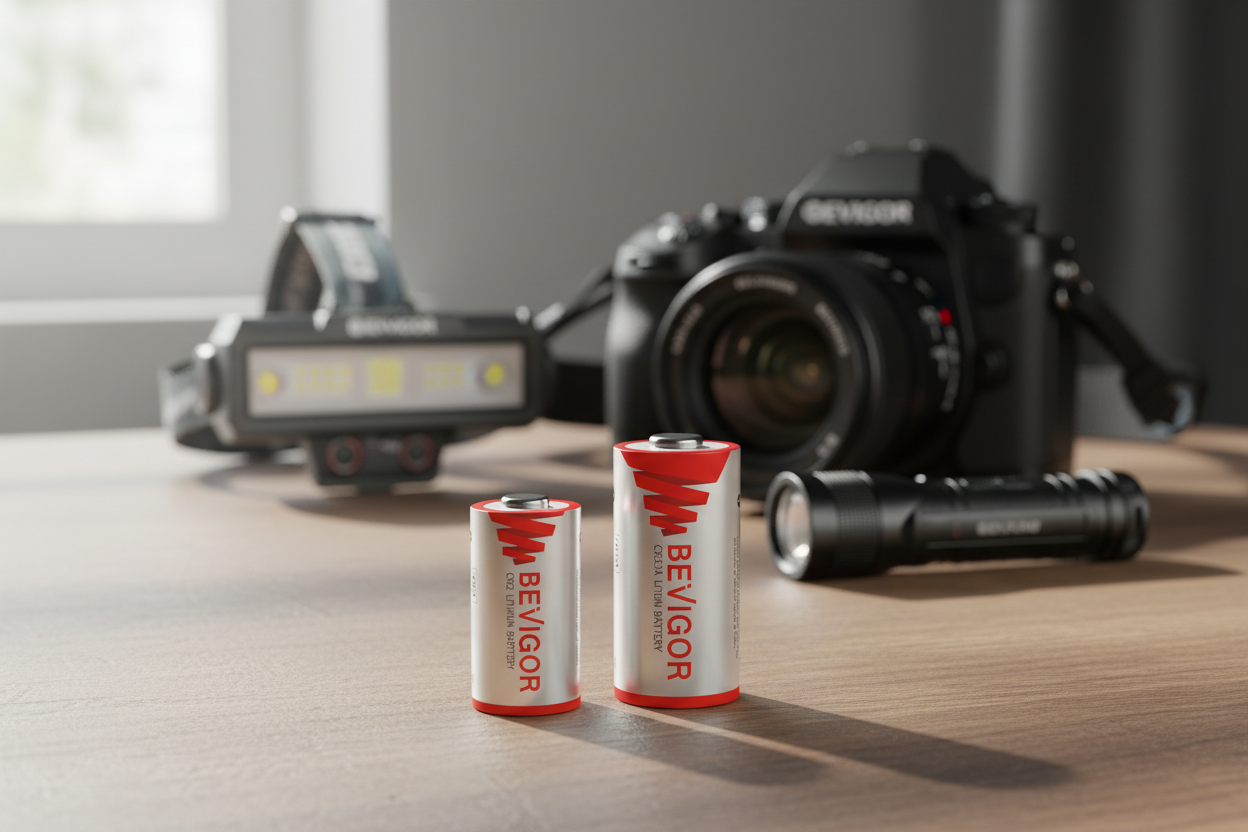
You slip a new battery into your high-end LED flashlight, smart security camera, or optical scope. It slides in smoothly, clicks into place against the metal terminals, and the battery compartment door seals perfectly. There is no physical friction, no wedging, and no tight-squeeze struggle. Physically, the fit is absolutely flawless. But when you flip the power switch, nothing happens. Or worse, you hear a tiny pop, followed by a faint, acrid smell of burnt circuitry drifting from the battery compartment. Your expensive electronic device is now a paperweight.

This scenario represents one of the most destructive and easily overlooked hazards in consumer electronics: the CR123A vs. 16340 voltage trap. Unlike physical compatibility issues, where a battery simply refuses to fit into an undersized tray, this is an issue of electrical compatibility. It is a trap where a rechargeable battery shares the exact same physical footprint as a standard primary cell but operates at a voltage high enough to instantly destroy sensitive electronics.
To protect your hardware, you must look past the physical dimensions of the battery bay and understand the invisible electrical properties at play.
The Illusion of a Perfect Footprint
In the consumer battery market, physical compatibility is often treated as the ultimate test of whether a battery is correct for a device. If it fits, we assume it is safe to use. But the naming standards and physical dimensions of modern lithium cells can easily obscure massive electrical differences.
When searching for sizing frameworks, a helpful reference is the standard (~List of battery sizes~) index, which details the nominal dimensions and design configurations of various cylindrical and button-type cells. In these systems, standard primary cells and rechargeable cells often share nearly identical physical envelopes.
For instance, the standard primary lithium CR123A battery is widely used in tactical flashlights, home security sensors, and cameras. It is a highly stable, single-use 3.0-volt cell.
On the other side of the equation sits the 16340 rechargeable lithium-ion battery. The designation "16340" is a literal description of its physical size under metric classification standards—roughly 16 mm in diameter and 34.0 mm in length. Because a standard CR123A cell measures almost exactly the same, the 16340 is frequently sold and used as a "rechargeable CR123A."
These physical dimensions may align perfectly with the tolerance limits of standard design frameworks such as IEC 60086. But while the physical envelopes are virtually interchangeable, their electrical baselines are fundamentally incompatible.
The Voltage Gap: 3.0V vs. 3.7V
The core of the trap lies in cellular chemistry and the resulting voltage output.
A standard, single-use primary CR123A battery uses Lithium Manganese Dioxide chemistry, which delivers a stable nominal output of 3.0 volts.
In contrast, a standard 16340 rechargeable battery uses a Lithium-ion chemistry. This chemistry operates at a nominal voltage of 3.6-3.7 volts. Even more critical is the charging peak: when a 16340 cell is taken fresh off a charger, its actual maximum voltage can reach up to 4.2 volts.
While a 0.7V to 1.2V difference might seem trivial on paper, the percentage increase is massive.
● Single-Cell Devices: A device designed to run on a single 3.0V CR123A is suddenly forced to handle up to 4.2V from a fully charged 16340. That is a 40% increase in voltage.
● Multi-Cell Devices: The problem compounds exponentially in devices that use multiple batteries in a series. A tactical flashlight utilizing two CR123A batteries is designed to operate on a 6.0V circuit. If a user swaps those primary cells for two fully charged 16340 rechargeable batteries, the input voltage surges to a staggering 8.4 volts.
This level of overvoltage quickly bypasses the safety thresholds of sensitive internal components.
Why Over-Voltage Destroys Components
When an overvoltage is applied to a device that lacks integrated voltage-regulation circuitry, the excess electrical energy must go somewhere. In most consumer electronics, this leads to immediate component failure:
● Overheated LED Drivers: High-performance flashlights use specialized driver boards to regulate the current flowing to the LED emitter. When hit with 8.4V instead of the expected 6.0V, these drivers generate excessive heat, causing the delicate solder joints to melt or the driver chip to burn out.
● Blown Capacitors: Standard capacitors on circuit boards are rated for specific maximum working voltages. Exceeding this rating causes dielectric breakdown, resulting in a short circuit and the component's physical failure.
● Fried Microcontrollers: In smart devices, such as wireless security cameras or motion sensors, microcontrollers manage the data transmission. These chips typically operate on low-voltage thresholds and have zero tolerance for unexpected voltage spikes.
Because these devices are built around compact, integrated circuit boards, a single fried component usually means the entire device must be replaced.
The Appeal and Danger of the "Rechargeable" Label
Consumers naturally want to avoid the ongoing cost and environmental waste of single-use primary batteries. This leads many to actively seek out rechargeable alternatives.
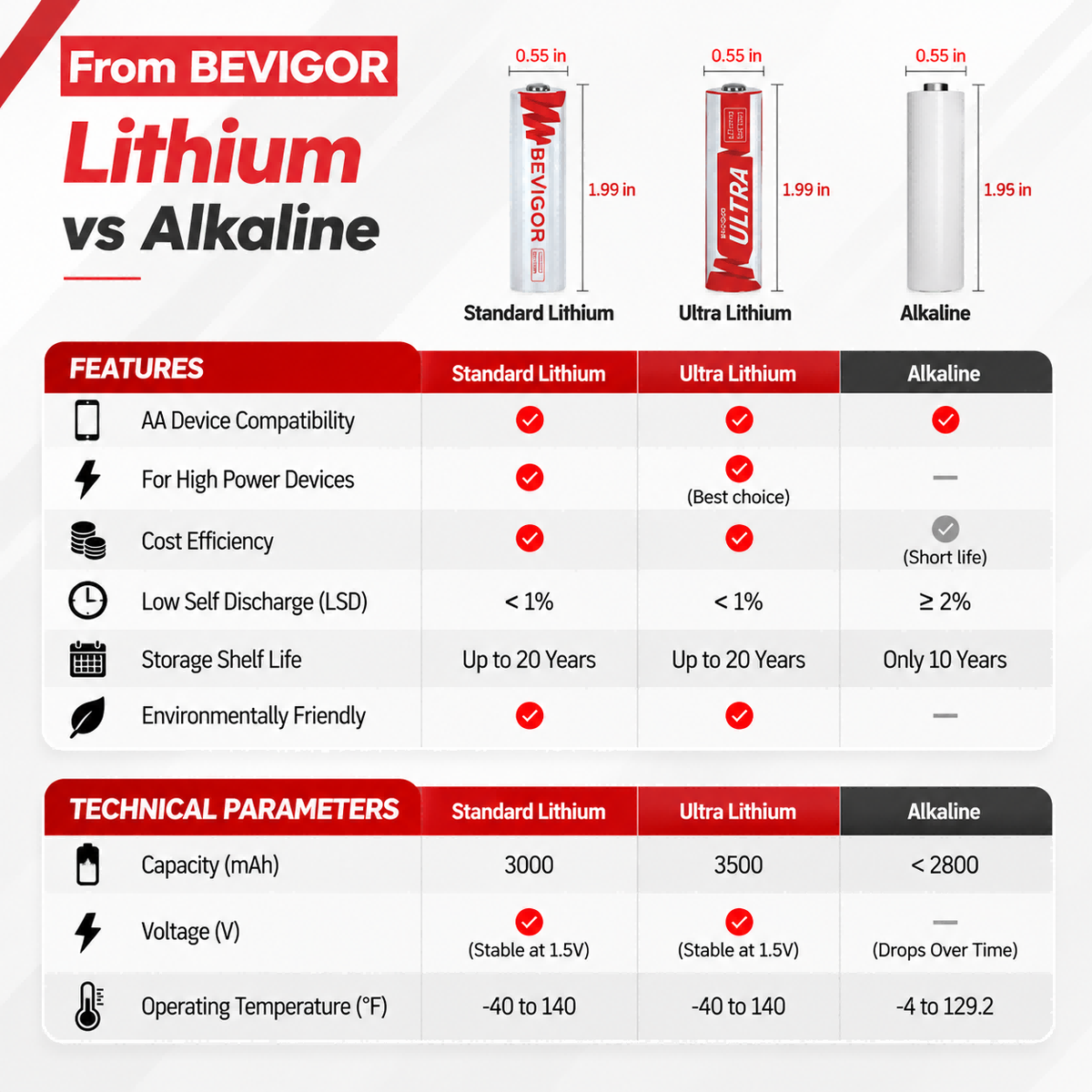
In standard household configurations, switching to rechargeables is incredibly safe. For example, comparing a Lithium AA vs. Lithium AAA Battery framework reveals that standard rechargeable NiMH batteries operate at a slightly lower nominal voltage (1.2V) than standard alkaline or lithium primary cells (1.5V). In those cases, the worst-case scenario of using a rechargeable is simply that a high-drain device might indicate a low battery slightly sooner. There is zero risk of physical or electrical damage.
With the CR123A footprint, however, the safety dynamic is completely reversed. Because the rechargeable lithium-ion alternative (16340) sits at a significantly higher voltage than the primary cell, the risk of damage is catastrophic.
Unless a device's manufacturer explicitly states in the user manual that the hardware is designed with a wide-input voltage regulator capable of accepting up to 4.2V (or 8.4V for dual-cell configurations), you must assume that inserting a standard 16340 rechargeable battery will destroy the device.
Safely Managing Your Power Needs
To avoid falling into the voltage trap while still trying to manage your devices efficiently, follow these technical best practices:
● Always Verify Device Specifications: Check your device's input voltage range before buying batteries. If the manual specifies a strict 3.0V limit, do not use standard rechargeable lithium-ion cells.
● Identify Voltage-Regulated Rechargeables: Some advanced rechargeable 16340 batteries are built with internal buck converter chips that actively step down the output voltage from the native 3.7V to a regulated, safe 3.0V. These specialty cells are safe for 3.0V electronics, but you must read the battery label carefully to verify the regulated output.
● Keep Chemistry Types Segregated: Never mix different battery chemistries, brands, or charge levels within the same device tray. Mixing a primary CR123A with a rechargeable 16340 can lead to rapid battery discharge, overheating, or leakage.
● Stick to Verified Form Factors: When physical safety and maximum reliability are required, use standard, high-quality AA Batteries or AAA Batteries for devices engineered for household-standard voltages. For systems that support safe, low-voltage recharging configurations, use a dedicated Rechargeable AA & AAA battery kit to maximize efficiency without jeopardizing your hardware investment.



Share:
How AA Battery Tolerance Stack-Up Ruins Product Design
The Safe DIY Guide to Fixing Tight Battery Trays