

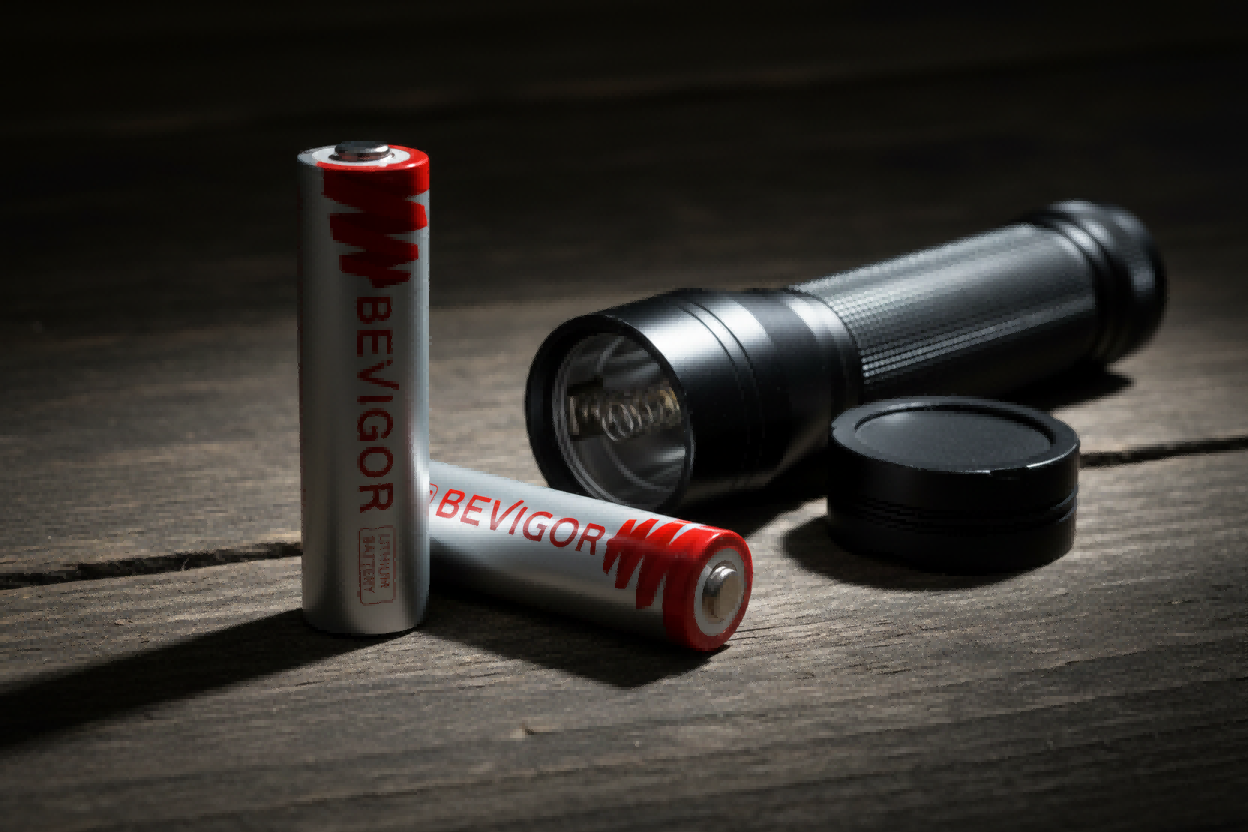
The cell looks like a normal AA. The label says "AA." But the battery tray won't accept it, or it fits so tightly you're afraid you'll damage the spring contact.
That frustration usually comes down to one thing: a size name like "AA" describes a standard form factor, not a guarantee that every AA-shaped product is identical across every dimension.
And when your battery compartment is designed with minimal clearance, "close enough" becomes "won't fit."
What "AA" and "AAA" actually standardize (and what they don't)
When people say AA batteries and AAA batteries, they're usually talking about physical size first.
A helpful baseline reference is Wikipedia's table of common battery sizes, which lists nominal dimensions for:
- AA (IEC R6): 14.5 mm diameter × 50.5 mm length
- AAA (IEC R03): 10.5 mm diameter × 44.5 mm length
Those nominal numbers are why AA and AAA are considered "standard." See the consolidated size table on Wikipedia's List of battery sizes.
But if you're troubleshooting a "won't fit" battery door, the more useful numbers are the allowed min–max limits (the effective tolerance window) used in the standards.
For primary cells, the international reference is IEC 60086. The IEC 60086-2 overview (primary batteries - physical and electrical specifications) is the governing document, and practical dimension summaries that reflect those limits are widely published.
For AA and AAA, Wikipedia's dimension sections summarize the standardized min–max limits:
- AA (IEC R6 / ANSI 15): 13.7–14.5 mm diameter, 49.5–50.5 mm length (includes the positive button terminal) per AA battery dimensions.
- AAA (IEC R03 / ANSI 24): 10.5 mm diameter, 44.5 mm length (includes the positive button terminal) per AAA battery dimensions.
That's why a product can be legitimately labeled "AA" yet still feel different in a very tight compartment, because the standards are not a single fixed millimeter measurement; they're a set of dimensional limits.
But here's the part that creates real-world fit problems: standards describe a form factor and naming system, while the market contains batteries that look like the same size but include extra features that change the outer dimensions.
In other words, "AA" can be a size… but not always the whole story.

Why rechargeable lithium AA batteries sometimes fail to fit your electronics tray
Most fit complaints show up with certain rechargeable "lithium AA" products, especially the ones that advertise a regulated 1.5V output.
A traditional rechargeable AA (like NiMH) is a relatively simple cylinder. But many 1.5V lithium-ion AA-style batteries are effectively a small lithium-ion cell plus electronics to make them behave like a 1.5V AA.
Wikipedia notes that AA-sized lithium-ion cells (14500) are different from standard AA, and that AA-sized lithium-ion cells with circuitry to reduce voltage to 1.5V are also made (AA battery - Wikipedia).
From a fit standpoint, this matters because:
- 14500 is an "AA-sized" lithium-ion format (roughly 14 × 50 mm), but real products may differ due to button-top style and protection circuits.
- IEC R6 / AA primary-cell limits are effectively 49.5–50.5 mm length and 13.7–14.5 mm diameter (AA dimensions). If your battery bay is built right up against those limits, small construction differences can decide whether the door closes.
Once you add circuitry, a few mechanical issues become more likely:
Added length from electronics and terminal design
Some 1.5V Li-ion "AA" designs place circuitry near the positive terminal. That can change how much of the "button" protrudes and how the top is constructed.
A technical write-up describing 1.5V Li-ion AA batteries as a smaller 3.7V cell paired with a DC-DC converter is here: Replacing 2 AA 1.5V batteries with 2 AA lithium batteries.
Even a fraction of a millimeter matters when a battery door is designed to compress the springs only slightly.
Slightly larger diameter from wraps and sleeves
To package electronics safely, some rechargeable lithium AA products use thicker outer wraps or sleeves. On paper, it's still "AA," but in a tight tray, the increased friction is enough to stop insertion.
"AA-sized" isn't always "AA-standard"
You'll also see products marketed as "AA lithium" that are actually closer to 14500 (a lithium-ion size code) or built around 14500 cells with added circuitry.
That's why you can have two items that both seem to be AA batteries, yet one slides into the tray and the other jams. For a complete guide on addressing these sizing and electronic jams, read why 1.5V rechargeable lithium AAs jam your devices (and how to fix it).
Tracking down true AA size standards for custom battery compartments
If you're designing a custom battery compartment (or even 3D-printing a holder), it's not enough to copy a single "AA length" number.
You need to design for:
- Nominal cell dimensions (the baseline)
- Terminal geometry (button height and how contacts land)
- Spring travel (how much compression room the device actually has)
- Insertion angle (many devices don't insert completely straight)
- Tolerance stack-up (small differences that add up)
As a baseline, start with the nominal dimensions summarized on Wikipedia's List of battery sizes. Then design your tray so it can tolerate small variations without requiring force.
If you're building a product, it's worth treating the battery bay like a mechanical system-not an ideal cylinder in a rigid enclosure.
The problem with oversized lithium AA brands-and how to avoid them
Let's translate "oversized brands" into something you can actually use:
The real problem isn't usually that a brand is "bad." It's that some lithium AA products are physically larger than the space your device allows, because of:
- a different terminal style (pronounced button-top)
- extra electronics (regulated 1.5V output)
- thicker jackets
- looser manufacturing tolerances
So how do you avoid buying the wrong ones?
Check the listing for actual millimeters.
If the product page includes length and diameter in mm, it's a good sign. Compare those numbers to the nominal AA size (and keep in mind that your device may not have much spring travel).
If a listing doesn't state dimensions at all, it's a gamble for tight compartments.
Match the battery type to the tray design.
If your device was built around primary (single-use) cells with predictable shapes, regulated rechargeable lithium AAs are more likely to be a tight fit than conventional NiMH rechargeables.
And if your tray uses flat contacts (instead of flexible springs), the terminal shape becomes even more important.
Understanding standard cylindrical cell millimeter allowances across brands
People often think of battery sizes as rigid numbers. In practice, fit is more like a chain of small tolerances.
Here's a simple way to picture it:
- The battery might be slightly longer.
- The wrapper might be slightly thicker.
- The tray's plastic rails might have slight molding variation.
- The spring might have stiffened over time.
Individually, each one is minor. Together, they create a jam.
That's tolerance stack-up: small manufacturing differences and design choices that add up to a real-world fit problem. To see how these physical variations affect device housing and assembly, read our detailed analysis on how AA battery tolerance stack-up ruins product design.
This is why two AA batteries that look interchangeable at a glance can behave very differently in the same device.
Here's a quick "fit reality" cheat sheet you can use when a compartment has almost no wiggle room:
|
Size name (common) |
Standard designation |
Nominal (what listings quote) |
Standardized limits (what fit depends on) |
|
AA |
IEC R6 / ANSI 15 |
14.5 × 50.5 mm |
13.7–14.5 mm Ø, 49.5–50.5 mm L (AA dimensions) |
|
AAA |
IEC R03 / ANSI 24 |
10.5 × 44.5 mm |
10.5 mm Ø, 44.5 mm L (AAA dimensions) |
|
14500 (Li-ion "AA-size") |
14500 |
14 × 50 mm |
Often close to 14 × 50 mm; protected versions can be longer (fit depends on construction). See the overview of "AA-sized lithium-ion (14500)" in AA battery-Wikipedia. |
|
CR123A |
IEC CR17345 |
~17 × 34.5 mm |
Often sold as 17 × 34.5 mm (CR17345). Example manufacturer datasheet: Energizer 123 (CR123A) Product Datasheet (PDF) |
|
16340 (Li-ion) |
16340 / RCR123A |
16 × 34 mm |
Often ~16 × 34 mm; can be longer with protection/button-top designs. |
A design rule of thumb (for device makers and DIY holders): if you want compliant batteries to fit comfortably, plan at least ~0.5 mm radial clearance and ~1.0 mm axial/spring travel beyond nominal, because the standards allow real variation, and springs/doors also have their own tolerances.
Fixing a tight battery tray squeeze without damaging your spring contacts
If you're already stuck with a tray that's too tight, the goal is to fix the cause, not to force the fit.
For step-by-step techniques on modifying battery compartments safely, check out the safe DIY guide to fixing tight battery trays.
Step 1: Confirm you're not fighting the wrong problem
If the tray only "almost" closes, double-check:
- You're not mixing AA and AAA batteries (it happens more than people want to admit)
- The cells are oriented correctly
- There isn't a battery already seated incorrectly underneath a contact tab
Step 2: Look for friction points, not "stubborn batteries"
Common culprits:
- A slightly warped battery door or latch
- Plastic flash (a tiny ridge) from molding inside the tray
- Corrosion residue or sticky leakage film that increases friction
A dry cotton swab and isopropyl alcohol can remove residue without attacking plastics.
Step 3: Protect the contacts-don't "bend until it works"
Battery contacts are springy by design, but they're not meant for repeated over-bending.
If you pry them up aggressively, you can end up with:
- weaker contact pressure (flickering power)
- broken weld points
- a door that no longer closes, even with normal cells
Pro Tip: If the battery is tight because the spring has little travel, try a different cell type before you try reshaping the device. It's usually cheaper to swap batteries than to replace a broken tray.
Step 4: What not to do
Avoid "DIY fixes" that create new risks:
- Don't sand a battery's metal can or wrapper (short-circuit risk)
- Don't crush or dent the can to make it thinner
- Don't force the door shut with tools
If the tray is undersized, the practical answer is to use a cell that matches the device's intended physical form factor.
Battery sizes beyond AA/AAA: CR2032 and CR123A confusion is common, too
AA and AAA aren't the only battery sizes people get burned by.
CR2032 battery: the name is the size
Coin cells are one place where the naming is refreshingly literal.
The IEC-style naming convention explained on Wikipedia's Button cell page notes:
- CR2032 → about 20 mm in diameter and 3.2 mm thick
So if a device calls for CR2032, you're looking for a battery size that should be consistent across brands, because the code encodes the dimensions. To decode other battery standard designations and naming conventions, see our guide on how to read your battery's name like a blueprint.
CR123A battery: same footprint, different voltage traps
CR123A is a common size in security devices and flashlights.
A quick reference table for the CR123A battery size (and its common equivalents like 16340) is shown on Wikipedia's List of battery sizes, which summarizes CR123A at around 17 mm × 34.5 mm.
The confusion comes from rechargeable substitutes:
- CR123A is typically a 3V primary lithium cell
- 16340 / RCR123A are often 3.6–3.7V rechargeable lithium-ion cells
Even if they fit physically, they can be electrically wrong for your device. For a practical overview of the naming and voltage difference, see CR123 vs. CR123A Batteries. To prevent electrical damage when selecting rechargeable alternatives, read the CR123A vs. 16340 voltage trap: protecting your electronics.
How to measure your device tray so you stop guessing
If you've ever returned batteries because they "should've fit," a simple measurement habit saves time.
Here's a fast method:
- Measure the battery you know fits (diameter and length) with a caliper.
- Measure the new battery the same way.
- Compare the difference.
Then check the tray itself:
- Measure the internal length between the positive and negative contact points.
- Press the spring contact gently and estimate how much travel you have before it bottoms out.
If the tray has almost no spring travel, you'll want batteries that are closer to nominal dimensions and have a terminal style similar to what the device shipped with.
AA vs AAA: when "battery sizes" aren't your real problem
Sometimes the device isn't picky about brands-it's picky about the job.
If your device is very power-hungry, AA batteries are common because they provide more capacity than AAA batteries in the same chemistry family. But if your device is compact and designed around minimal space, AAA batteries may be used specifically because the tray geometry is tighter.
If you want a plain-English refresher on how AA vs AAA differs in practice, this guide is a useful companion: Lithium AA vs Lithium AAA Battery.
Next steps
If you're shopping for AA batteries or AAA batteries and you've already dealt with a tight compartment once, choose products that clearly state their size and intended use.
You can browse:
And if rechargeability is part of your plan, start with standard-form-factor options like a rechargeable AA/AAA set: Rechargeable AA & AAA batteries.



Share:
Child Safety Laws vs Accessibility: Reese's Law and the New Reality of Button Battery Packaging
Trail Camera Battery Checklist for Deer Hunting Season