

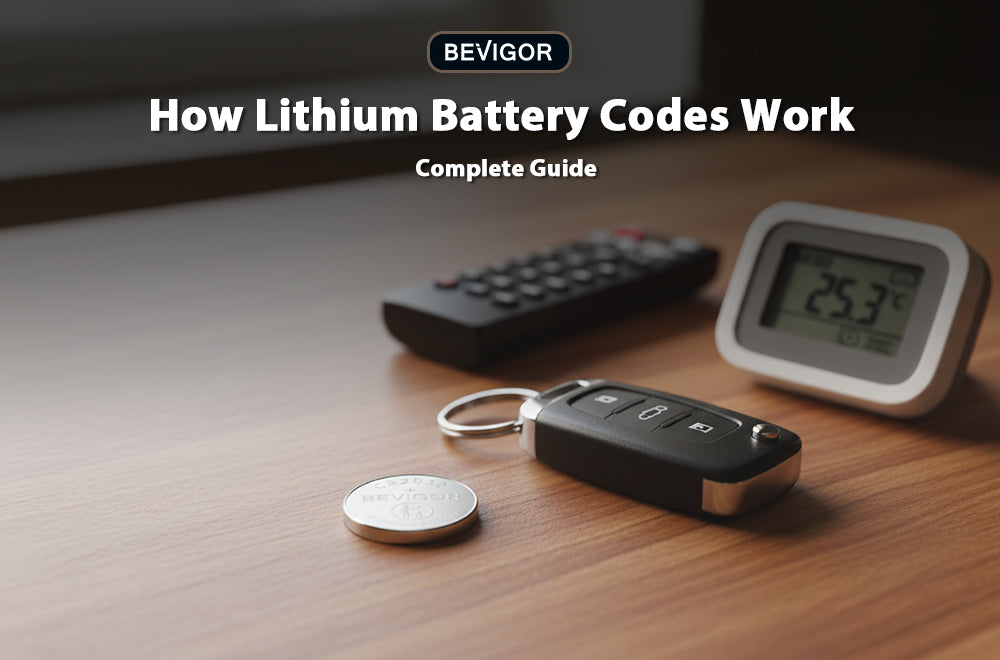
Most lithium coin cells labeled "CR" follow a size pattern.
- CR2032: about 20 mm diameter, 3.2 mm thick
- CR2025: about 20 mm diameter, 2.5 mm thick
- CR2016: about 20 mm diameter, 1.6 mm thick
- CR2450: about 24 mm diameter, 5.0 mm thick
Those tiny thickness differences matter because coin-cell devices are basically spring-and-contact systems. The battery has to be thick enough to press firmly against both contacts.

How Do The Number Codes on Lithium Batteries Work?
The number codes on lithium batteries work by specifying the exact physical diameter and height of the cell using a standardized measurement system defined by the International Electrotechnical Commission (IEC). Once you understand this numeric formula, you will never have to guess whether a cell will fit your device.
What Does The "CR" Prefix Mean for Lithium Batteries?
The "CR" prefix means that these lithium batteries utilize a manganese dioxide chemistry (represented by the "C") and feature a round, cylindrical physical shape (represented by the "R"). This designation separates them from other chemistries, such as silver-oxide, ensuring you are purchasing the correct voltage output for your electronics.
How Does The First Number Indicate The Diameter of Lithium Batteries?
The first two digits in the code indicate the diameter of lithium batteries by representing the measurement in exact millimeters. For example, the "20" in a CR2032 cell signifies that the battery is 20 millimeters across, while the "24" in a CR2450 means the battery measures roughly 24 millimeters in diameter.
What Do The Last Digits Reveal About The Thickness of Lithium Batteries?
The last two digits reveal the thickness of lithium batteries by stating the measurement in tenths of a millimeter. Therefore, the "32" in a CR2032 code tells you the cell is exactly 3.2 millimeters thick, and the "16" in a CR2016 cell denotes a much thinner 1.6-millimeter profile.
Why Are CR2032, CR2025, And CR2016 Lithium Batteries Easily Confused?
These three specific lithium batteries are easily confused because their diameters are entirely identical, making them look indistinguishable when viewed from above. What changes is thickness, and thickness affects both fit and runtime.
Why Do These Specific Lithium Batteries Look Identical from The Top?
These specific lithium batteries look identical from the top because they all share the exact same 20-millimeter diameter requirement. When they are sitting flat on a table or inside blister packaging, you cannot perceive the vertical differences, which is why consumers often mistakenly purchase the wrong variant for their key fobs or medical devices.
How Does The Thickness Differ Among These Lithium Batteries?
The thickness differs among these lithium batteries by stepping down incrementally: the CR2032 is 3.2 millimeters thick, the CR2025 drops to 2.5 millimeters, and the CR2016 is halved to 1.6 millimeters. These precise, sub-millimeter measurements dictate exactly how much energy-producing material fits inside the metal casing.
What Happens If You Swap The Wrong Sizes of These Lithium Batteries?
If you swap the wrong sizes of these lithium batteries, your device will likely experience intermittent power failures, mechanical jamming, or a completely broken battery housing. A practical way to think about it: if you're in doubt, don't "upgrade." Match the code.
How Does Thickness Impact The Fit of Lithium Batteries?
Thickness impacts the fit of lithium batteries by determining whether the cell can maintain continuous, solid tension against the device's internal metal connections. If the vertical height is incorrect, the electrical circuit simply cannot close securely.
Why Are Spring Systems Crucial for Lithium Batteries?
Spring systems are crucial for lithium batteries because coin-cell compartments rely exclusively on mechanical tension to keep the battery physically anchored and electrically active. The battery has to be thick enough to press firmly against both contacts, ensuring that vibration or movement does not sever the connection.
What Occurs When You Use Thinner Lithium Batteries in A Deep Slot?
When you use thinner lithium batteries in a deep slot designed for a CR2032, a smaller CR2025 or CR2016 will float loosely between the contacts and cause the device to randomly lose power. It might work temporarily in some devices, but it can also cause intermittent contact the moment the item is bumped or moved.
How Can Thicker Lithium Batteries Damage A Device?
Thicker lithium batteries can damage a device because forcing a thick cell into a slim compartment places immense stress on the delicate plastic hinges and the metal contacts. If the compartment was designed for a CR2025, a CR2032 may be too thick, and you can crack the plastic battery holder or jam the door.
What Should You Know About CR2450 Lithium Batteries?
You should know that CR2450 lithium batteries are significantly larger and thicker power sources designed explicitly for equipment that requires extended service intervals. You'll see it when a product needs a coin cell with more runtime and the compartment is physically bigger.
How Are CR2450 Lithium Batteries Different from The 20mm Series?
CR2450 lithium batteries are different from the 20mm series because they possess a wider 24-millimeter diameter and a massive 5.0-millimeter thickness. This bulky form factor means they hold dramatically more chemical reactant, making them visually and physically distinct from standard cells.
Why Do Manufacturers Choose CR2450 Lithium Batteries for Devices?
Manufacturers choose CR2450 lithium batteries for devices because the larger capacity drastically extends the time between required replacements. Some devices use CR2450 because they need a longer service interval, not because they're more "power hungry." In other words, CR2450 can be about maintenance convenience as much as electrical demand.
What Prevents You from Substituting CR2450 Lithium Batteries into Smaller Compartments?
The physical width and depth prevent you from substituting CR2450 lithium batteries into smaller compartments; you can't substitute CR2450 into a CR2032 compartment because it won't fit. The metal casing will aggressively jam against the plastic walls before it ever reaches the electrical contacts.
Why Do Some Lithium Batteries Have Different Letter Prefixes?
Some lithium batteries have different letter prefixes because specific battery manufacturers use proprietary branding codes instead of strictly adhering to the universal IEC standard naming convention.
What Do Brand Codes Like DL Or ECR Mean for Lithium Batteries?
Brand codes like DL or ECR mean that the lithium batteries were manufactured by specific companies like Duracell or Energizer, respectively, but they still represent the exact same physical size as the standard CR equivalent. You may see other codes listed on packaging that look like "DL2032" or "ECR2032."
How Can You Identify The True Size of Branded Lithium Batteries?
You can identify the true size of branded lithium batteries by ignoring the manufacturer's letter prefix and focusing entirely on the four-digit numerical code printed at the end. Whether the package says DL2032, ECR2032, or KCR2032, the "2032" confirms it retains the necessary 20-millimeter diameter and 3.2-millimeter thickness.
Why Is Matching The Exact Code for Lithium Batteries Safest?
Matching the exact code for lithium batteries is safest because doing so eliminates all guesswork regarding physical tolerances and ensures flawless electrical contact within the device housing. Your safe approach is still: match the physical size code your device asks for, preventing mechanical damage and unreliable performance.
How Does Physical Size Relate to The Runtime of Lithium Batteries?
The physical size relates to the runtime of lithium batteries by directly dictating how much active chemical material is stored inside the casing, which completely defines the cell's total energy capacity.
Why Do Thicker Lithium Batteries Last Longer in Devices?
Thicker lithium batteries last longer in devices because the added vertical height provides a larger internal volume to pack in more lithium and manganese dioxide fuel. More chemical fuel translates directly into a higher milliampere-hour (mAh) rating, extending the operational life of the battery.
What Is The Typical Capacity Difference Among These Lithium Batteries?
The typical capacity difference among these lithium batteries is substantial: a thick CR2032 provides roughly 220 to 240 mAh, while the slimmer CR2025 drops to around 160 mAh, and the ultra-thin CR2016 offers only about 90 mAh. This means a CR2032 can often last more than twice as long as a CR2016 under the exact same electrical load.
How Can Operating Conditions Drain These Lithium Batteries Faster?
Operating conditions drain these lithium batteries faster when the device is exposed to extreme cold temperatures, which slows the internal chemical reaction, or when the cell is subjected to continuous, high-pulse electrical draws. For instance, a smart home sensor pinging a wireless network frequently will exhaust the chemical fuel far quicker than a simple digital watch.



Share:
Coin Cell Lithium Battery Safety: What Every Household Should Know
Coin Cell Lithium Battery Buying Tip: Diameter Matters, but Thickness Usually Causes Problems